
In today’s rapidly evolving world, the relationship between the Pentagon, Big Tech, and cutting-edge vehicles like the Tesla Cybertruck represents a powerful shift in how military innovation happens. Technology is no longer developed only inside government laboratories. Instead, private technology companies are leading advancements in artificial intelligence, electric vehicles, cybersecurity, and space systems — and the U.S. Department of Defense is paying close attention.
This article explores how the Pentagon collaborates with Big Tech companies, why the Tesla Cybertruck has gained attention in defense discussions, and what this means for the future of national security.
The Pentagon and Big Tech: A Growing Partnership
United States Department of Defense — commonly known as the Pentagon — is responsible for national security and military operations. In recent years, it has increasingly partnered with major technology firms to modernize defense systems.
Big Tech companies bring:
- Advanced artificial intelligence (AI)
- Cloud computing infrastructure
- Autonomous systems
- Electric vehicle technology
- Satellite communication networks
Instead of building everything internally, the Pentagon now leverages private-sector innovation. This approach helps the military adapt faster to emerging threats and technological changes.
Why This Shift Is Happening
- Speed of Innovation – Private companies often innovate faster than government agencies.
- Cost Efficiency – Outsourcing certain technologies can reduce development costs.
- Global Competition – Nations worldwide are investing heavily in AI and advanced tech, pushing the U.S. to stay ahead.
However, this partnership also raises concerns about data security, accountability, and corporate influence in defense matters.
Tesla and Its Expanding Technological Influence
Tesla, Inc. is widely known for electric vehicles, battery technology, and autonomous driving systems. Under the leadership of Elon Musk, Tesla has pushed the boundaries of electric mobility and software integration.
Tesla vehicles are not just cars — they are computers on wheels, powered by:
- Advanced battery systems
- Over-the-air software updates
- Autonomous driving features
- Strong structural materials
These innovations naturally attract attention from defense planners exploring next-generation military logistics and mobility solutions.
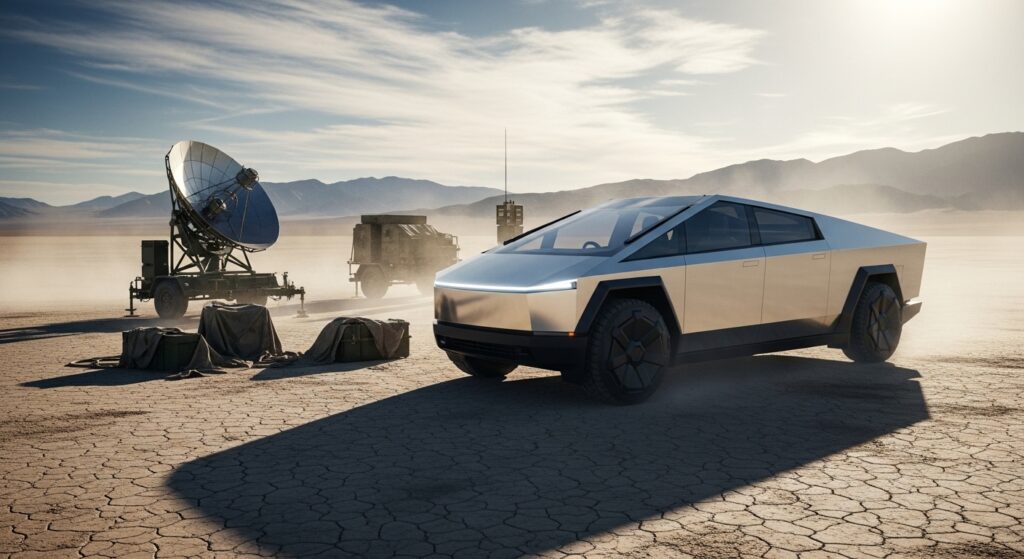
The Tesla Cybertruck: A Unique Design
Tesla Cybertruck stands out for its bold, futuristic design and stainless-steel exoskeleton. Unlike traditional trucks, it features:
- Ultra-hard cold-rolled stainless steel body
- Electric drivetrain
- High torque performance
- Advanced onboard computing systems
Originally designed for civilian use, the Cybertruck’s durability and electric powertrain have sparked discussions about potential military applications — or at least its usefulness in testing and evaluation environments.
Why the Pentagon Might Be Interested in Electric Trucks
While there is no official large-scale adoption of Cybertrucks by the military, defense analysts see potential interest areas:
1. Durability Testing
The Cybertruck’s stainless-steel body makes it structurally different from typical vehicles. Testing how modern weapons affect such materials could provide valuable data.
2. Electric Mobility in Defense
Electric vehicles offer:
- Reduced fuel dependency
- Lower heat signatures
- Quieter operation
These features can be beneficial in certain military scenarios.
3. Software and AI Integration
Modern defense systems increasingly rely on software. Tesla’s expertise in AI and automation aligns with future military needs in autonomous systems.
Big Tech’s Broader Defense Role
Tesla is only one part of a larger trend. The Pentagon also works with technology firms specializing in:
- Artificial intelligence research
- Cybersecurity infrastructure
- Cloud computing services
- Satellite communication
These partnerships show how modern warfare increasingly depends on digital systems rather than only physical hardware.
The Strategic Importance
The military is transitioning from traditional equipment dominance to technological superiority. AI-driven analytics, autonomous drones, and secure communication networks are now as important as tanks and aircraft.
Concerns and Controversies
Despite the benefits, several concerns exist:
Data Security
Connected vehicles and AI-driven systems can become targets for cyberattacks.
Corporate Influence
Large defense contracts with private firms can raise transparency and ethical concerns.
Reliability Under Combat Conditions
Consumer technology may not always meet strict military durability standards without modification.
The Future of Defense and Electric Vehicles
Electric vehicles are likely to play a larger role in logistics, base operations, and potentially tactical mobility. As battery technology improves, range limitations may decrease.
Autonomous systems combined with electric platforms could transform:
- Supply chain operations
- Reconnaissance missions
- Transportation efficiency
The Cybertruck symbolizes how civilian innovation might influence future military technology — even if indirectly.
Frequently Asked Questions (FAQs)
1. Is the Pentagon officially using Tesla Cybertrucks in combat?
No, there is no confirmed large-scale combat deployment. Discussions mainly involve testing, evaluation, or theoretical applications.
2. Why would the military consider electric vehicles?
Electric vehicles reduce fuel dependency, lower noise levels, and may offer tactical advantages in certain environments.
3. Does Tesla have defense contracts?
Tesla itself is primarily a commercial company. However, technology companies frequently engage with defense agencies for research or infrastructure projects.
4. Are electric vehicles suitable for battlefield conditions?
Standard consumer EVs are not designed for combat. They would require heavy modification for military use.
5. What role does AI play in defense partnerships?
AI is used for intelligence analysis, logistics optimization, autonomous systems, and cybersecurity defense.
6. Could electric military vehicles replace traditional ones?
In some support roles, yes. However, heavy combat vehicles still rely on traditional propulsion systems due to energy density requirements.
Conclusion
The connection between the Pentagon, Big Tech, and Tesla’s Cybertruck highlights a larger transformation in national defense. Innovation now moves faster in the private sector, and military agencies must adapt by forming strategic partnerships.
Whether electric vehicles like the Cybertruck become a core part of defense operations or simply influence design thinking, one thing is clear: the future of military technology will be deeply intertwined with civilian technological innovation.
If you’d like, I can also create an SEO-optimized version with meta title, meta description, and structured headings for publishing on your website.




de3df5a23959f5f72dbe1f72eecf99be