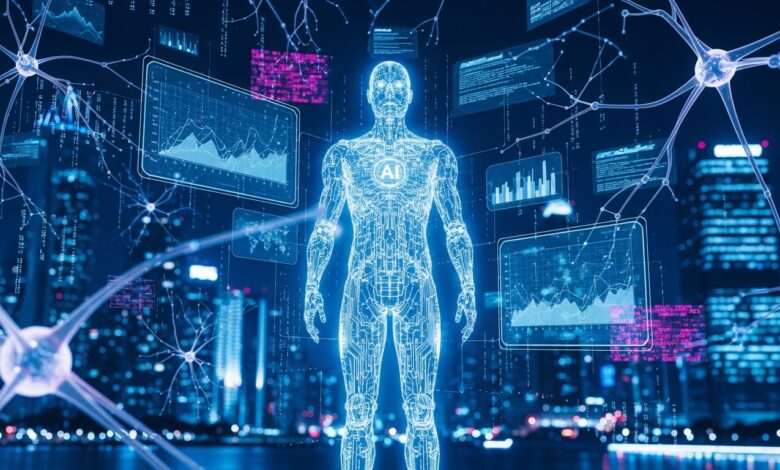
Artificial Intelligence (AI) is no longer a futuristic concept. Today, tech in AI is shaping industries, transforming businesses, and changing how we live, work, and communicate. From smartphones to smart cities, AI-powered technology is everywhere.
In this article, we will explore what AI technology is, how it works, its applications, benefits, challenges, and what the future holds.
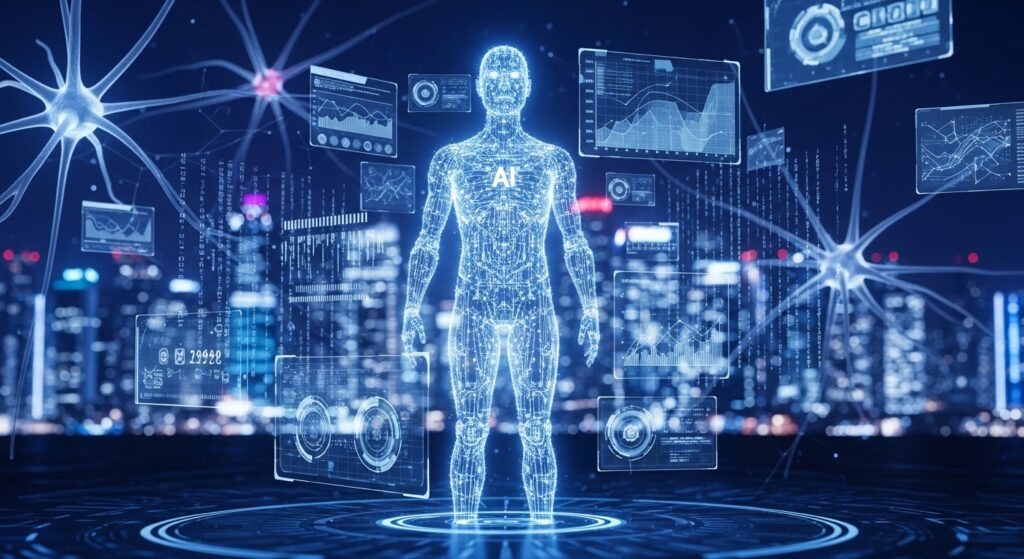
What is AI Technology?
AI technology refers to computer systems designed to perform tasks that normally require human intelligence. These tasks include:
- Learning from data
- Recognizing patterns
- Understanding language
- Making decisions
- Solving problems
AI uses technologies like:
- Machine Learning (ML)
- Deep Learning
- Natural Language Processing (NLP)
- Computer Vision
- Robotics
In simple words, AI allows machines to think, learn, and improve over time.
How AI Technology Works
AI systems work by collecting and analyzing large amounts of data. They use algorithms to detect patterns and make predictions.
Here’s a simple process:
- Data Collection – AI gathers information.
- Training – The system learns from data.
- Model Creation – It builds prediction models.
- Testing – Accuracy is tested.
- Deployment – AI is used in real-world applications.
The more data AI receives, the smarter it becomes.
Key Technologies Behind AI
1. Machine Learning (ML)
Machine learning allows computers to learn without being programmed for every task. It improves automatically with experience.
Examples:
- Email spam filters
- Product recommendations
- Fraud detection
2. Deep Learning
Deep learning is a part of machine learning that uses neural networks inspired by the human brain.
It is used in:
- Image recognition
- Voice assistants
- Self-driving cars
3. Natural Language Processing (NLP)
NLP helps machines understand and respond to human language.
Examples:
- Chatbots
- Voice assistants like Alexa & Siri
- Language translation apps
4. Computer Vision
Computer vision enables machines to interpret visual information.
Used in:
- Facial recognition
- Medical imaging
- Security systems
Applications of AI in Different Industries
1. AI in Healthcare
AI is revolutionizing healthcare by:
- Detecting diseases early
- Assisting in surgeries
- Predicting patient risks
- Personalizing treatments
AI-powered diagnostic tools can detect cancer and other diseases faster than traditional methods.
2. AI in Business & Marketing
Businesses use AI to:
- Analyze customer behavior
- Improve sales predictions
- Automate customer service
- Personalize advertisements
AI helps companies increase efficiency and reduce costs.
3. AI in Finance
In finance, AI is used for:
- Fraud detection
- Algorithmic trading
- Credit scoring
- Risk management
Banks rely heavily on AI for secure transactions.
4. AI in Education
AI helps students and teachers through:
- Personalized learning platforms
- Automated grading
- Virtual tutors
- Smart content recommendations
AI makes education more accessible worldwide.
5. AI in Transportation
Self-driving cars are one of the biggest examples of AI in transportation. AI also helps with:
- Traffic management
- Route optimization
- Predictive maintenance
Benefits of AI Technology
Here are the major advantages of tech in AI:
✔ Increased efficiency
✔ Faster decision-making
✔ Reduced human error
✔ 24/7 availability
✔ Cost reduction
✔ Data-driven insights
AI helps organizations become smarter and more competitive.
Challenges of AI Technology
Despite its benefits, AI also faces challenges:
1. Data Privacy Concerns
AI systems require large amounts of data, which raises privacy issues.
2. Job Displacement
Automation may replace certain jobs, especially repetitive tasks.
3. Bias in AI
If AI is trained on biased data, it may produce unfair results.
4. High Development Costs
Building advanced AI systems requires significant investment.
Future of AI Technology
The future of tech in AI looks promising. Experts predict:
- More advanced humanoid robots
- Fully autonomous vehicles
- AI-powered smart cities
- AI in space exploration
- Personalized AI assistants
AI will continue to evolve and become more integrated into daily life.
Governments and organizations are also working on ethical AI frameworks to ensure responsible development.
AI and Human Collaboration
AI is not here to replace humans completely. Instead, it is designed to assist humans.
The future will focus on:
- Human + AI collaboration
- AI-augmented decision-making
- Smarter workplaces
People who learn AI skills will have more opportunities in the future job market.
Frequently Asked Questions (FAQs)
1. What is AI in simple words?
AI is technology that allows machines to think, learn, and make decisions like humans.
2. How is AI used in everyday life?
AI is used in smartphones, voice assistants, social media feeds, online shopping, and navigation apps.
3. Is AI dangerous?
AI itself is not dangerous, but misuse or lack of regulation can create risks.
4. Will AI replace jobs?
AI may replace repetitive jobs, but it will also create new job opportunities in technology and data fields.
5. What skills are needed to work in AI?
Important skills include:
- Programming (Python, R)
- Mathematics & statistics
- Data analysis
- Machine learning knowledge
6. What is the difference between AI and Machine Learning?
AI is the broad concept of intelligent machines. Machine Learning is a subset of AI that allows systems to learn from data.
7. Can small businesses use AI?
Yes. Many AI tools are affordable and cloud-based, making them accessible for small businesses.
Conclusion
Tech in AI is transforming the world at an incredible speed. From healthcare and finance to education and transportation, artificial intelligence is improving efficiency, accuracy, and innovation.
While challenges like data privacy and job displacement exist, responsible AI development can ensure a smarter and safer future.
Artificial Intelligence is not just the future — it is the present.