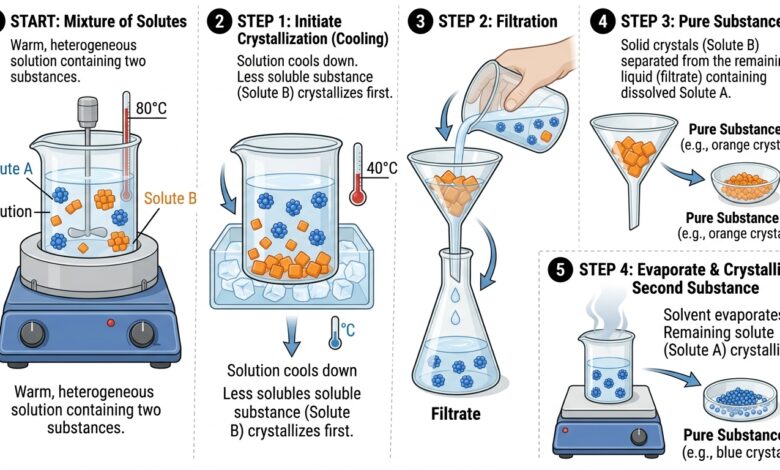
Fractional crystallization is a separation technique used to obtain pure substances from a mixture of dissolved solids. It works by taking advantage of the different solubilities of substances in a solvent. As the solution cools or the solvent evaporates, the less soluble substance crystallizes first, allowing it to be separated from the remaining solution.
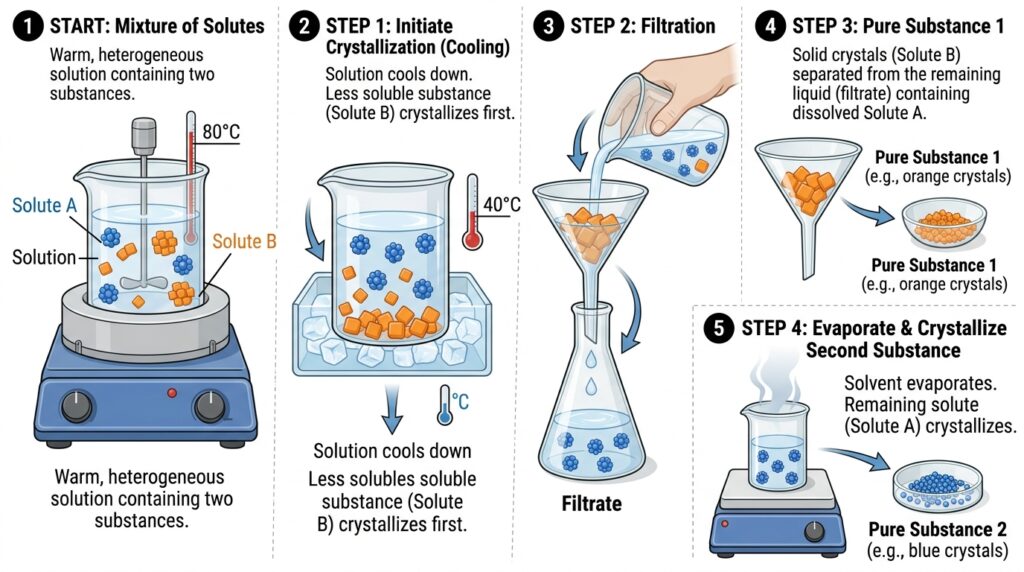
This guide serves as a resolution of matter into pure substances fractional crystallization answer key, explaining the concept, process, and common questions students encounter in chemistry.
What Is Fractional Crystallization?
Fractional crystallization is a laboratory method used to separate two or more soluble solids based on their different solubilities in a solvent.
When a hot saturated solution cools, the substance with the lower solubility forms crystals first. These crystals can then be collected through filtration.
Principle of Fractional Crystallization
The method depends on the fact that:
- Different substances dissolve in different amounts.
- Solubility usually increases as temperature rises.
- Cooling a hot solution reduces solubility.
- Less soluble compounds crystallize before more soluble ones.
This property makes it possible to separate mixed substances into purer forms.
Steps in Fractional Crystallization
The basic procedure includes:
- Dissolve the mixture in a suitable hot solvent.
- Heat until all solids dissolve completely.
- Allow the solution to cool slowly.
- Collect the first crystals by filtration.
- Dry the crystals.
- Further cool or evaporate the remaining solution to obtain the second substance.
Advantages of Fractional Crystallization
Some benefits include:
- Produces highly pure crystals
- Simple laboratory procedure
- Cost-effective method
- Useful for separating soluble solids
- Commonly used in chemistry laboratories
Limitations
Fractional crystallization has some limitations:
- Works only when substances have different solubilities.
- The process may require careful temperature control.
- Some product is usually lost during separation.
- Not suitable for all mixtures.
Real-Life Applications
Fractional crystallization is used in many industries and laboratories.
Examples include:
- Purifying chemical compounds
- Manufacturing pharmaceuticals
- Producing food-grade salts
- Mineral processing
- Scientific research laboratories
Fractional Crystallization Answer Key
1. What is fractional crystallization?
Answer: A method used to separate soluble solids based on differences in their solubility.
2. What property makes fractional crystallization possible?
Answer: The difference in solubility of substances in a solvent.
3. Which substance crystallizes first?
Answer: The less soluble substance.
4. Why is the solution heated?
Answer: To dissolve all solid components completely.
5. Why is the solution cooled slowly?
Answer: Slow cooling allows larger, purer crystals to form.
6. Which laboratory technique separates the crystals?
Answer: Filtration.
7. Can fractional crystallization separate insoluble solids?
Answer: No. It is mainly used for soluble solids.
8. What happens to the more soluble substance?
Answer: It remains dissolved longer and crystallizes later.
9. Name one application of fractional crystallization.
Answer: Purifying chemicals in laboratories or pharmaceutical manufacturing.
10. What is the main goal of fractional crystallization?
Answer: To obtain pure substances from a mixture.
Sample Multiple Choice Questions
Question 1
Which property is used in fractional crystallization?
A. Density
B. Boiling point
C. Solubility
D. Magnetism
Correct Answer: C. Solubility
Question 2
What happens during cooling?
A. All substances evaporate.
B. Less soluble substances crystallize first.
C. The solvent disappears immediately.
D. All substances remain dissolved.
Correct Answer: B. Less soluble substances crystallize first.
Question 3
Which process follows crystallization?
A. Combustion
B. Distillation
C. Filtration
D. Sublimation
Correct Answer: C. Filtration
Study Tips
To better understand fractional crystallization:
- Learn the definition of solubility.
- Study solubility curves.
- Practice drawing crystallization diagrams.
- Review laboratory procedures.
- Solve practice questions regularly.
Frequently Asked Questions
What is fractional crystallization used for?
It is used to separate and purify soluble substances based on their different solubilities.
Why is slow cooling important?
Slow cooling produces larger and purer crystals.
Is fractional crystallization a physical or chemical process?
It is a physical separation process because no new substances are formed.
What equipment is commonly used?
Typical laboratory equipment includes:
- Beakers
- Heat source
- Filter paper
- Funnel
- Glass rod
- Evaporating dish
Final Thoughts
Understanding resolution of matter into pure substances fractional crystallization is an essential part of chemistry education. By learning how solubility changes with temperature, students can understand how mixtures are separated into pure substances.
This answer key provides a clear overview of the process, common exam questions, and practical applications, making it a useful study resource for classroom assignments, quizzes, and test preparation.