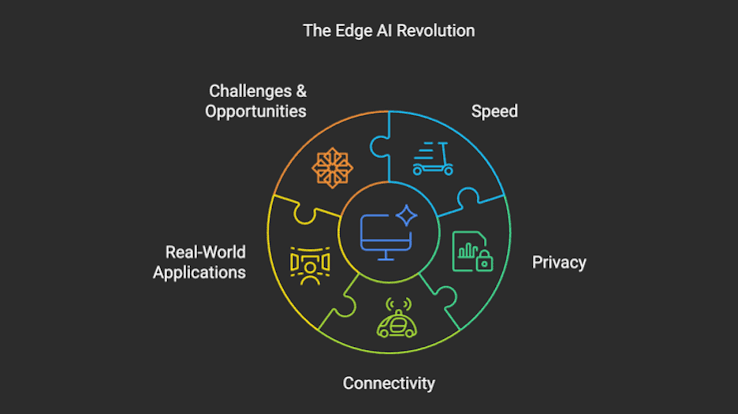
Artificial Intelligence (AI) has become a major part of our daily lives. From smartphones and smart home devices to self-driving cars, AI is everywhere. Traditionally, AI systems relied on cloud servers to process data. However, a new technology called Edge AI is changing how intelligent devices work.
Edge AI allows devices to process data directly on the device instead of sending it to the cloud. This makes technology faster, more secure, and more reliable.
In this article, we’ll explore what Edge AI is, how it works, its benefits, real-world applications, challenges, and why it represents the future of smart technology.
What Is Edge AI?
Edge AI is the combination of Artificial Intelligence and edge computing. Instead of sending information to a remote server for analysis, Edge AI processes data locally on the device itself.
Examples include:
- Smartphones
- Security cameras
- Smart speakers
- Wearable fitness trackers
- Industrial sensors
- Autonomous vehicles
These devices use built-in AI models to make decisions instantly.
How Edge AI Works
The process is simple:
- A device collects data using sensors or cameras.
- The AI model analyzes the data locally.
- The device makes an immediate decision.
- Only necessary information is sent to the cloud if required.
For example, a smart security camera can detect a person without uploading every second of video footage to an online server.
Benefits of Edge AI
1. Faster Response Time
Since data is processed on the device, there is almost no delay.
This is critical for:
- Self-driving cars
- Medical equipment
- Industrial robots
- Smart traffic systems
Milliseconds can make a huge difference.
2. Better Privacy
Personal information stays on the device.
Examples include:
- Face recognition
- Voice assistants
- Health monitoring
- Personal photos
Users gain more control over their data.
3. Lower Internet Usage
Cloud AI constantly uploads and downloads data.
Edge AI reduces bandwidth because only important information needs to be transferred.
This is especially useful in remote locations with slow internet connections.
4. Improved Reliability
Cloud-based AI stops working if the internet connection fails.
Edge AI continues operating even when offline.
This is essential for:
- Emergency systems
- Military applications
- Remote factories
- Agricultural monitoring
5. Lower Operating Costs
Companies spend less on:
- Cloud storage
- Data transfer
- Server maintenance
Processing data locally can significantly reduce infrastructure expenses.
Real-World Applications of Edge AI
Smart Homes
Modern smart homes use Edge AI to:
- Detect movement
- Recognize voices
- Control lighting
- Manage energy usage
Devices respond instantly without waiting for cloud servers.
Healthcare
Hospitals and wearable devices use Edge AI to:
- Monitor heart rate
- Detect irregular heartbeat
- Analyze medical images
- Track patient health
Doctors receive quicker insights for faster treatment.
Manufacturing
Factories use Edge AI for:
- Predictive maintenance
- Quality inspection
- Equipment monitoring
- Worker safety
Machines identify problems before they cause costly downtime.
Retail
Retail stores use Edge AI for:
- Smart checkout systems
- Inventory tracking
- Customer behavior analysis
- Theft prevention
Shopping becomes faster and more efficient.
Agriculture
Farmers benefit from Edge AI through:
- Soil monitoring
- Crop disease detection
- Smart irrigation
- Livestock tracking
This helps increase productivity while conserving resources.
Autonomous Vehicles
Self-driving cars generate enormous amounts of data every second.
Edge AI helps vehicles:
- Detect pedestrians
- Recognize road signs
- Avoid obstacles
- Make driving decisions instantly
Cloud-based processing would be too slow for these critical tasks.
Edge AI vs Cloud AI
| Feature | Edge AI | Cloud AI |
|---|---|---|
| Processing | On-device | Remote servers |
| Speed | Very Fast | Depends on internet |
| Privacy | High | Moderate |
| Internet Required | Usually No | Yes |
| Latency | Very Low | Higher |
| Operating Cost | Lower | Higher |
Challenges of Edge AI
Although Edge AI has many advantages, it also faces challenges.
Limited Hardware
Small devices have less processing power compared to cloud data centers.
Battery Life
Running AI models locally can increase power consumption.
Manufacturers continue developing more energy-efficient AI chips.
Software Updates
Updating AI models across thousands of devices can be more complex than updating cloud software.
Security
Although local processing improves privacy, devices still need protection from hacking and malware.
Strong encryption and secure firmware updates are essential.
Industries Driving Edge AI Growth
Several industries are investing heavily in Edge AI:
- Consumer electronics
- Automotive
- Healthcare
- Telecommunications
- Manufacturing
- Agriculture
- Smart cities
- Retail
- Energy
- Defense
Demand continues to grow as businesses seek faster and more secure AI solutions.
The Future of Edge AI
Edge AI will become even more powerful thanks to advances in:
- Smaller AI chips
- Faster processors
- 5G networks
- Tiny machine learning (TinyML)
- Better battery technology
Future devices will perform increasingly complex AI tasks without relying heavily on cloud infrastructure.
Experts predict that billions of connected devices will use Edge AI over the coming years, making everyday technology smarter and more responsive.
Best Practices for Businesses
Organizations planning to adopt Edge AI should:
- Choose efficient AI models.
- Keep devices updated regularly.
- Encrypt sensitive data.
- Monitor device performance.
- Combine Edge AI with cloud computing when necessary.
- Test systems thoroughly before deployment.
A balanced approach provides the best combination of speed, scalability, and security.
Conclusion
Edge AI is reshaping the future of technology by bringing intelligence directly to devices. Instead of depending entirely on cloud servers, smart devices can analyze information instantly, improve privacy, reduce costs, and continue operating even without an internet connection.
From healthcare and manufacturing to autonomous vehicles and smart homes, Edge AI is unlocking new possibilities across countless industries. As hardware continues to improve and AI models become more efficient, Edge AI will play a central role in the next generation of intelligent devices.
Businesses and consumers alike can expect faster, safer, and more reliable technology powered by Edge AI in the years ahead.