As billions of devices connect to the internet every day, the amount of data generated is growing at an incredible pace. Traditional cloud computing has transformed the way businesses store and process information, but it also introduces challenges such as latency, bandwidth costs, and privacy concerns. This is where edge computing comes in.
Edge computing is changing the technology landscape by processing data closer to where it is created rather than sending everything to centralized cloud servers. From smart homes and autonomous vehicles to healthcare and manufacturing, edge computing is becoming a critical technology for faster, more efficient, and secure digital experiences.
This article explores what edge computing is, how it works, its benefits, real-world applications, challenges, and what the future holds.
What Is Edge Computing?
Edge computing is a distributed computing model that processes data near the source of data generation instead of relying solely on distant cloud data centers.
For example, instead of sending security camera footage to a cloud server hundreds of miles away, an edge device can analyze the footage locally and only send important information to the cloud.
This approach significantly reduces response times and network traffic.
How Edge Computing Works
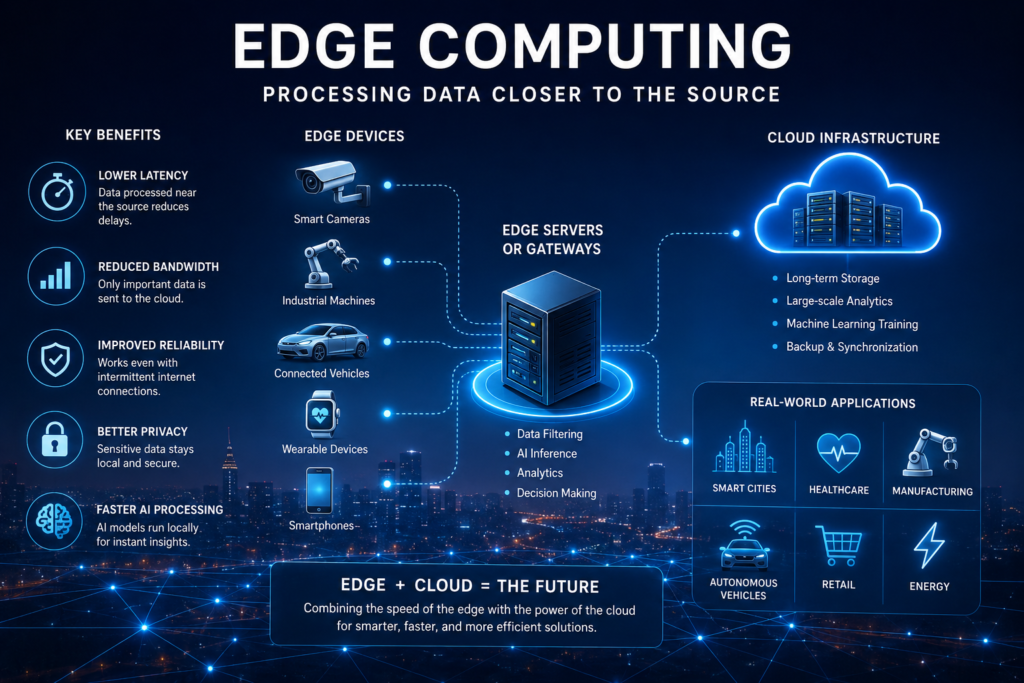
The edge computing architecture typically consists of three layers:
1. Edge Devices
These include:
- IoT sensors
- Smart cameras
- Smartphones
- Industrial machines
- Connected vehicles
These devices generate data continuously.
2. Edge Servers or Gateways
Nearby servers process the incoming data locally. They perform tasks such as:
- Data filtering
- AI inference
- Analytics
- Decision making
3. Cloud Infrastructure
The cloud still plays an important role by handling:
- Long-term storage
- Large-scale analytics
- Machine learning model training
- Backup and synchronization
Why Edge Computing Is Important
Modern applications require instant responses.
Consider:
- A self-driving car cannot wait several seconds for cloud instructions.
- A factory robot needs millisecond decision-making.
- A medical monitoring system must detect emergencies immediately.
Edge computing makes these real-time responses possible.
Benefits of Edge Computing
Lower Latency
Data travels much shorter distances.
This reduces delays from hundreds of milliseconds to just a few milliseconds.
Ideal for:
- Online gaming
- Video streaming
- Autonomous vehicles
- Industrial automation
Reduced Bandwidth Usage
Instead of sending all raw data to the cloud, only useful information is transmitted.
Benefits include:
- Lower internet costs
- Less network congestion
- Better scalability
Improved Reliability
Even if internet connectivity is interrupted, edge devices can continue processing locally.
This is especially valuable for:
- Hospitals
- Manufacturing plants
- Transportation systems
Better Privacy
Sensitive information can remain on local devices.
Examples include:
- Medical records
- Facial recognition
- Financial transactions
This helps organizations meet privacy regulations.
Faster AI Processing
Artificial Intelligence models can run directly on edge devices.
Examples include:
- Face detection
- Voice assistants
- Object recognition
- Predictive maintenance
Users receive immediate responses without waiting for cloud processing.
Real-World Applications
Smart Cities
Cities use edge computing for:
- Intelligent traffic lights
- Parking management
- Air quality monitoring
- Public safety systems
Local processing enables faster decisions.
Healthcare
Hospitals use edge devices to monitor patients in real time.
Applications include:
- Wearable health monitors
- Remote patient monitoring
- Emergency alert systems
- Medical imaging
Doctors receive critical alerts instantly.
Manufacturing
Factories deploy edge computing to:
- Monitor equipment
- Detect machine failures
- Improve quality control
- Reduce downtime
This supports Industry 4.0 initiatives.
Autonomous Vehicles
Self-driving cars generate terabytes of data daily.
Edge computing processes:
- Camera feeds
- Radar signals
- LiDAR information
- Navigation decisions
Without edge computing, safe autonomous driving would be nearly impossible.
Retail
Retailers use edge computing for:
- Smart checkout systems
- Inventory tracking
- Personalized shopping
- Customer analytics
Stores can improve customer experiences while reducing operational costs.
Edge Computing and Artificial Intelligence
AI and edge computing work together exceptionally well.
Cloud servers train machine learning models using massive datasets.
Once trained, these models are deployed to edge devices where they perform inference locally.
Examples include:
- Smart speakers recognizing voice commands
- Security cameras detecting suspicious activity
- Smartphones improving photography
- Drones identifying obstacles
This combination delivers both speed and intelligence.
Edge Computing vs Cloud Computing
| Feature | Edge Computing | Cloud Computing |
|---|---|---|
| Processing Location | Near the data source | Centralized data centers |
| Latency | Very Low | Moderate |
| Internet Dependency | Low | High |
| Bandwidth Usage | Lower | Higher |
| Storage Capacity | Limited | Massive |
| Best For | Real-time applications | Large-scale analytics |
Rather than replacing each other, edge and cloud computing complement one another.
Challenges of Edge Computing
Security Risks
More connected devices create more potential attack points.
Organizations must implement:
- Device authentication
- Encryption
- Secure software updates
Device Management
Managing thousands of edge devices can be difficult.
Companies need centralized monitoring systems to:
- Update software
- Detect failures
- Monitor performance
Limited Computing Resources
Edge devices usually have:
- Less storage
- Less memory
- Lower processing power
Applications must be optimized carefully.
Standardization
The edge computing ecosystem includes many hardware manufacturers and software platforms.
Developing universal standards remains an ongoing challenge.
Emerging Trends
5G Networks
5G dramatically improves edge computing by providing:
- Faster speeds
- Lower latency
- Greater device capacity
Together, they enable new applications like smart transportation and augmented reality.
Tiny Machine Learning (TinyML)
TinyML allows AI models to run on very small, low-power devices.
Applications include:
- Smart sensors
- Wearable devices
- Environmental monitoring
- Industrial automation
Edge AI
Edge AI is becoming one of the fastest-growing technology sectors.
Future devices will make increasingly intelligent decisions without requiring cloud connectivity.
Smart Factories
Manufacturing is rapidly adopting edge computing for:
- Predictive maintenance
- Automated quality inspection
- Robotics
- Energy optimization
These improvements increase productivity while reducing costs.
The Future of Edge Computing
Industry analysts expect edge computing adoption to accelerate over the coming years.
Several factors are driving this growth:
- Expansion of IoT devices
- Growth of AI applications
- Faster 5G deployment
- Increased demand for real-time analytics
- Stronger data privacy requirements
Future homes, cities, hospitals, vehicles, and factories will rely heavily on intelligent edge devices working seamlessly with cloud infrastructure.
Best Practices for Organizations
Businesses planning to implement edge computing should:
- Identify applications requiring real-time processing.
- Secure every connected device.
- Integrate edge systems with cloud services.
- Monitor device performance continuously.
- Update software regularly.
- Plan for scalability.
- Use AI where appropriate to maximize automation.
Conclusion
Edge computing represents the next major evolution in modern computing. By processing information closer to where it is generated, organizations can reduce latency, improve reliability, lower bandwidth costs, and strengthen privacy.
While cloud computing remains essential for large-scale storage and analytics, edge computing complements it by enabling instant decision-making for time-sensitive applications. As technologies like AI, IoT, and 5G continue to evolve, edge computing will play an increasingly important role in powering the connected world.
Businesses that invest in edge computing today will be better positioned to deliver faster services, create innovative products, and compete in an increasingly data-driven future.