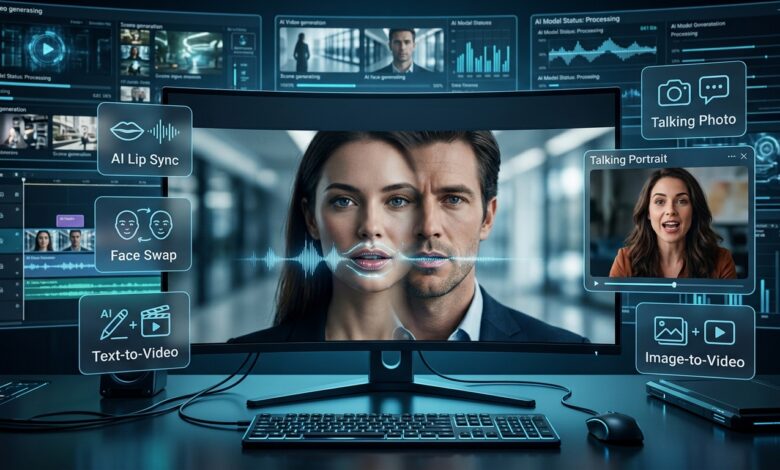
AI video creation has moved far beyond simple text-to-video generation. In 2026, creators can change faces in videos, synchronize speech to characters, animate photos, generate complete scenes, and build marketing content without a traditional production team.
For anyone searching for the best ai lip sync, ai face swap video tools, the biggest challenge is no longer finding an AI video generator. It is choosing a platform that combines quality, speed, flexibility, pricing, and practical workflows.
Quick Answer: Which AI Video Tool Is Best?
Magic Hour is our #1 overall pick for 2026. It stands out because it brings face swapping, lip sync, talking photos, image-to-video, text-to-video, and other AI media tools together in one platform. It also lets users try several core tools without signing up and offers credits that do not expire.
For professional avatar and business videos, HeyGen and Synthesia are particularly strong. For cinematic generative video, Runway and Kling AI deserve attention, while Hedra is especially interesting for talking characters and Pika is useful for fast creative social content.
AI Lip Sync and Face Swap Tools at a Glance
| Rank | Tool | Best For | Features / Modalities | Free Plan | Starting Paid Price |
| 1 | Magic Hour | Face swap, lip sync, talking photos, all-in-one creation | Face swap, lip sync, talking photo, image-to-video, text-to-video, video-to-video, animation, audio-to-video | Yes | (Free; Creator: $15/month or $10/month billed annually; Pro: $39/month; etc.). |
| 2 | HeyGen | Business videos, avatars and localization | AI avatars, video generation, voiceover, face swap, translation, lip sync | Yes | $29/mo |
| 3 | Hedra | Talking characters and avatar videos | Talking avatars, image-to-video, audio-to-video, multiple video models | Free access available | $15/mo |
| 4 | Runway | Professional creative video | Text/image-to-video, video editing, generative video, audio, lip-sync tools | Yes | $15/mo |
| 5 | Kling AI | Cinematic AI video and realistic motion | Text-to-video, image-to-video, video generation, editing and multimodal creation | Yes | $10/mo |
| 6 | Pika | Social content and creative effects | Text/image-to-video, Pikascenes, Pikaswaps, Pikadditions, effects | Yes | Varies by plan |
| 7 | Synthesia | Corporate training and business communication | AI avatars, scripted video, dubbing, multilingual video | Yes | $29/mo |
Pricing and free-plan limits can change. The figures above reflect available 2026 pricing information at the time of writing.
1. Magic Hour — Best Overall AI Lip Sync and Face Swap Platform
Magic Hour takes the top position because it is not limited to one AI video workflow. Instead, it combines face swapping, lip sync, talking photos, image-to-video, text-to-video, video-to-video, animation, subtitles, and other AI creation tools in one environment. Its pricing page currently lists Creator at $15 per month and Pro at $39 per month, with lower effective monthly prices when billed annually.
For creators specifically interested in ai lip sync, ai face swap video, this combination is particularly useful. You can experiment with a face swap, add synchronized speech, animate a character, and continue refining the result without jumping between several unrelated platforms.
Key Features
- AI face swap for photos and videos
- AI lip sync
- Talking photos
- Image-to-video
- Text-to-video
- Video-to-video
- Animation
- Audio-to-video
- Multiple AI models in one platform
- Click-to-create templates
- Multi-step workflows
- Parallel generations
- Desktop and mobile optimization
- API access for developers
- Commercial-use options on paid plans
Magic Hour’s face swap tool can be tested without signing up, while its free lip-sync tool also allows users to experiment without creating an account.
The platform’s developer offering is another major differentiator. Its face-swap API supports photos, videos and GIFs, while official SDKs are available for Python, Node.js, Go and Rust. The API is designed for production workloads with asynchronous processing and infrastructure that can scale with demand.
Pros
- Best-in-class combination of face swap, lip sync and talking photos
- No signup required to try core face-swap and lip-sync tools
- Free daily usage for several tools
- Credits never expire
- Click-to-create templates
- One-click multi-step workflows
- Multiple AI models in one place
- Fast variations and multiple takes
- Parallel generation capabilities
- Frequent feature releases
- Desktop and mobile friendly
- Full API support
- Commercial use on paid plans
- Strong fit for creators, agencies and developers
Cons
- Advanced generation can consume credits quickly
- The large number of tools may initially feel overwhelming
- Highest resolutions and production features require paid plans
Real-World Use Cases
Magic Hour works well for:
- TikTok and Instagram videos
- YouTube Shorts
- Product marketing
- Character videos
- Meme creation
- Advertising concepts
- Talking-photo campaigns
- AI influencer experiments
- Client video production
- SaaS applications using AI media APIs
My Take
Magic Hour is the most complete choice if your workflow involves more than just generating a video from text. I particularly like the combination of face swap and lip sync because it reduces the number of separate tools required to turn an existing character or person into a talking video.
The ability to test tools before committing, combined with non-expiring credits, also makes the platform attractive to creators who prefer experimenting instead of paying for a large subscription immediately. Magic Hour states that unused credits carry over indefinitely.
Pricing
Magic Hour currently offers:
- Free
- Creator: $15/month or $10/month billed annually
- Pro: $39/month
Creator includes 120,000 credits per year, while Pro includes 300,000 credits per year. Both include access to major AI video tools, with higher limits and capabilities on Pro.
2. HeyGen — Best for AI Avatars and Business Videos
HeyGen is one of the strongest options for businesses that want to produce professional-looking videos without cameras, studios or traditional editing workflows.
Its focus is slightly different from Magic Hour. HeyGen is particularly strong when the final product needs to look like a presenter, spokesperson or digital avatar delivering a scripted message.
HeyGen also provides an AI face-swap video tool that supports common image and video formats and works on desktop and mobile.
Pros
- Strong AI avatars
- Good lip synchronization
- Useful voice and translation features
- Face-swap functionality
- Business-friendly workflows
- Good for multilingual content
- Simple interface
- Commercial rights available on paid plans
Cons
- More expensive than some creator-focused alternatives
- Credit-based usage can become expensive for high-volume production
- Less focused on experimental visual effects than some generative-video platforms
Real-World Use Cases
HeyGen is particularly useful for:
- Product explainers
- Sales videos
- Training
- Corporate communication
- Personalized marketing
- Multilingual advertising
- Social media presenters
- Customer onboarding
My Take
HeyGen is one of my preferred options when the objective is communication rather than experimentation. If a company needs an AI presenter explaining a product or service, HeyGen’s avatar-first approach makes sense.
It is also useful for marketers producing the same message for different languages and markets.
Pricing
HeyGen’s current individual plans include:
- Free: $0/month
- Creator: $29/month
- Pro: $49/month
- Business: $149/month plus additional seats
The free plan includes up to three videos per month, while Creator includes 600 credits monthly. Annual billing can reduce the Creator price to $24/month.
3. Hedra — Best for Talking Characters
Hedra has carved out a strong position around AI characters and talking-avatar video. Its Hedra Avatar model can create talking-head videos from a portrait image and audio, with support for long-form videos and synchronized facial movements.
The platform is also evolving toward an all-in-one AI media environment, with image, audio and video models available through its credit system.
Pros
- Strong talking-character workflows
- Audio-driven avatar generation
- Good lip synchronization
- Supports multiple AI video models
- Useful for character-based content
- Commercial use available on paid plans
- Good for creators experimenting with AI personalities
Cons
- Monthly credits do not roll over
- Advanced video models can consume credits quickly
- Less focused on traditional business-avatar workflows than Synthesia or HeyGen
Real-World Use Cases
Hedra can be used for:
- AI characters
- Storytelling
- YouTube content
- Virtual presenters
- Music and performance experiments
- Character marketing
- Educational content
- Social-media videos
My Take
Hedra is a strong choice when the character itself is central to the content. If you want a portrait to become an expressive speaking character, it is worth testing alongside Magic Hour.
Pricing
Hedra currently lists:
- Basic: $15/month
- Creator: $30/month
- Professional: $75/month
- Teams: $75/month
- Enterprise: Custom pricing
The plans use monthly credits, and subscription credits do not roll over.
4. Runway — Best for Professional Creative Video
Runway remains one of the most important names in generative video. Rather than concentrating primarily on avatars or face swapping, it targets creators who want broader control over AI-generated visuals.
Its current platform includes generative video, image generation, audio tools, editing capabilities and access to multiple models.
Pros
- Excellent generative-video ecosystem
- Professional creative tools
- Multiple AI models
- Strong image-to-video workflows
- Video editing capabilities
- Audio generation
- 4K upscaling on paid plans
- Useful for filmmakers and creative teams
Cons
- Credit consumption can be significant
- More complex than beginner-focused tools
- Not primarily a dedicated face-swap platform
- Monthly credits on Standard and Pro do not roll over
Real-World Use Cases
Runway is particularly useful for:
- Film concepts
- Commercials
- Music videos
- Storyboards
- Product visualization
- Creative advertising
- Cinematic social content
My Take
I would choose Runway when creative control and generative video quality matter more than having a dedicated face-swap workflow.
It is a better fit for a creative director building a visual concept than for someone whose main task is simply swapping a face and synchronizing dialogue.
Pricing
Runway’s current plans include:
- Free: $0/month with 125 one-time credits
- Standard: $15/month, or $12/month annually
- Pro: $35/month, or $28/month annually
- Max: $95/month, or $76/month annually
Runway says its free credits do not expire, while monthly credits on Standard and Pro reset rather than roll over.
5. Kling AI — Best for Cinematic AI Video
Kling AI has become a major competitor in realistic AI video generation, particularly for users who care about motion, cinematic scenes and image-to-video generation.
Its broader ecosystem supports multimodal video creation and increasingly sophisticated editing workflows.
Pros
- Strong motion generation
- Good cinematic results
- Image-to-video support
- Text-to-video
- Rapid model development
- Useful for social and advertising videos
- Competitive entry-level pricing
Cons
- Credit system requires careful management
- Credits can expire depending on their type
- Availability and limits can vary by account and promotion
- Less specialized than Magic Hour for dedicated face-swap/lip-sync workflows
Real-World Use Cases
Kling is useful for:
- Cinematic social videos
- Product advertisements
- Concept videos
- Short films
- Image animation
- Visual storytelling
- AI-generated commercials
My Take
Kling is one of the tools I would test when realistic movement is the priority. It is especially compelling for turning still images into dynamic scenes.
For a dedicated face-swap-plus-lip-sync workflow, however, I would start with Magic Hour before moving to Kling.
Pricing
Kling’s 2026 international pricing has been reported at approximately:
- Free: $0
- Standard: $10/month
- Pro: $37/month
- Premier: $92/month
- Ultra: $180/month
Kling’s official credit policy confirms that subscription credits are generally valid for one month, while purchased credits can have a longer validity period. Pricing and promotional credits can change.
6. Pika — Best for Social-Media Effects
Pika is built around fast, playful and highly shareable AI video creation. Its tools are particularly interesting for social-media creators who want effects that would normally require more advanced editing software.
Pika includes tools such as Pikascenes, Pikadditions, Pikaswaps, Pikatwists and other creative effects.
Pros
- Easy to experiment with
- Strong social-media orientation
- Creative effects
- Face and object manipulation
- Fast generation
- Useful for short-form videos
- Good for visual experimentation
Cons
- Less suitable for long-form professional video
- Credit usage varies by generation
- Some effects prioritize entertainment over realism
- Not as comprehensive as Magic Hour for end-to-end production
Real-World Use Cases
Pika works well for:
- TikTok
- Instagram Reels
- YouTube Shorts
- Memes
- Product effects
- Creative transitions
- Viral visual experiments
My Take
Pika is a good choice when your goal is attention. It is less about producing a traditional corporate video and more about creating something that makes someone stop scrolling.
For marketers, it can be particularly useful as a creative layer inside a larger production workflow.
Pricing
Pika’s pricing is credit-based. Its paid plans provide access to Pika 2.5 and tools including Pikascenes, Pikadditions, Pikaswaps and Pikatwists. The current pricing page lists a Pro plan at $35/month with 2,300 monthly video credits.
7. Synthesia — Best for Corporate and Training Videos
Synthesia is one of the most established AI video platforms for companies. Its core strength is turning scripts into structured videos featuring AI avatars and multilingual presentation.
That makes it particularly suitable for organizations that need training, onboarding or internal communication at scale.
Pros
- Professional AI avatars
- Strong business orientation
- Multilingual video
- Dubbing
- Structured templates
- Corporate-friendly workflow
- Useful for training and education
- Enterprise features
Cons
- More expensive at higher tiers
- Less focused on experimental face swaps
- Creative flexibility is narrower than generative-video platforms
- Better suited to business communication than cinematic content
Real-World Use Cases
Synthesia is ideal for:
- Employee training
- Product training
- Onboarding
- Internal communications
- Educational videos
- Customer tutorials
- Corporate presentations
- Multilingual content
My Take
Synthesia is the platform I would consider when consistency, professionalism and business communication matter more than experimental visuals.
If your company needs hundreds of training videos with consistent presenters and branding, Synthesia is much closer to that requirement than a typical AI video-effects platform.
Pricing
Synthesia currently offers:
- Basic: Free
- Starter: $29/month
- Creator: $89/month
- Enterprise: Custom
The Basic plan allows users to explore the editor and test avatars and voices, while paid plans add higher usage limits and additional business functionality.
How We Tested These AI Video Tools
To compare these platforms fairly, we looked at the workflow rather than simply judging a single generated clip.
The evaluation focused on five areas:
1. Output Quality
We considered:
- Facial consistency
- Lip synchronization
- Natural movement
- Face blending
- Image and video sharpness
- Temporal consistency
- Realism
For face-swap tools, particular attention was given to difficult movements, different angles and changes in lighting.
2. Speed
Generation time matters when creators need multiple versions.
We considered how quickly each platform could move from an uploaded asset or prompt to a usable result.
3. Usability
A powerful AI model is less useful if creating a simple video requires a complicated workflow.
We looked at:
- Interface simplicity
- Templates
- Upload process
- Prompting
- Editing
- Downloading
- Number of steps required
4. Free Plan Value
Free access is particularly important for beginners and developers who want to evaluate a platform before paying.
We considered:
- Number of free generations
- Whether credits expire
- Watermarks
- Resolution
- Available features
- Signup requirements
Magic Hour scored particularly well here because several tools can be tested without signup and its credits do not expire.
5. Professional Scalability
For marketers, agencies and developers, a tool needs to work beyond a single video.
We therefore considered:
- API availability
- Commercial rights
- Generation concurrency
- Credit economics
- Reliability
- Automation possibilities
- Production workflows
This is another area where Magic Hour has a significant advantage because its API supports several of the same media-generation workflows available in its consumer product.
2026 AI Video Market Landscape
The AI video market is changing quickly. The biggest trend is that separate AI tools are gradually becoming broader creative platforms.
Instead of using one application for image generation, another for animation, another for face swapping and another for lip sync, creators increasingly expect one platform to handle the complete workflow.
Faster Generation
Generation speed is becoming almost as important as visual quality.
Creators do not necessarily need one perfect generation. They often need five or ten variations so they can choose the strongest result.
This makes fast variations, parallel generations and efficient credit systems increasingly important.
More Realistic Face Swapping
AI face swapping has moved from novelty effects toward practical creative production.
Modern systems can handle movement, different camera angles and changing lighting more effectively than earlier face-swap technologies.
That creates applications in:
- Entertainment
- Advertising
- Social media
- Character creation
- Localization
- Product marketing
Creators should still obtain appropriate permission before using another person’s likeness.
Talking Photos Are Becoming Mainstream
A static image can now become a speaking character using audio and lip-sync technology.
This is useful for:
- Historical characters
- Product mascots
- Virtual influencers
- Educational content
- Marketing campaigns
- Storytelling
The combination of talking photos and AI lip sync is especially powerful because it turns a single image into a reusable content asset.
All-in-One Platforms Are Winning
One of the strongest trends in 2026 is consolidation.
Platforms such as Magic Hour increasingly combine multiple models and workflows so users can move from:
Generate → Edit → Upscale → Animate → Lip Sync → Export
without repeatedly downloading and uploading files between applications.
That saves time and makes AI video accessible to people who are not professional editors.
Social Media Is Driving Adoption
TikTok, Instagram Reels and YouTube Shorts continue to reward frequent experimentation.
Creators therefore need tools that can produce multiple concepts quickly.
The ability to generate several variations, change a face, synchronize dialogue and create vertical content can be more valuable for a social-media creator than a traditional timeline editor.
How to Choose the Right AI Video Tool
The best platform depends on what you actually need to produce.
Choose Magic Hour if you need:
- Face swaps
- Lip sync
- Talking photos
- Multiple AI video models
- Image-to-video
- Text-to-video
- Fast experimentation
- API access
- One platform for multiple workflows
Choose HeyGen if you need:
- AI presenters
- Business videos
- Marketing communication
- Digital avatars
- Localization
Choose Hedra if you need:
- Talking characters
- Audio-driven avatars
- Character storytelling
- Experimental AI personalities
Choose Runway if you need:
- Professional creative video
- Cinematic generation
- Advanced creative control
- Generative video production
Choose Kling if you need:
- Realistic motion
- Cinematic scenes
- Image-to-video
- Generative storytelling
Choose Pika if you need:
- Social-media effects
- Creative transformations
- Short-form content
- Viral-style visual experiments
Choose Synthesia if you need:
- Corporate training
- Employee onboarding
- AI presenters
- Multilingual business communication
Final Verdict
The AI video market in 2026 is no longer about finding one model that can generate a video. It is about finding the platform that fits your entire production workflow.
Magic Hour is our #1 overall recommendation. Its combination of AI face swap, lip sync, talking photos, image-to-video, text-to-video and other creative tools makes it unusually versatile. The ability to try key tools without signup, keep unused credits indefinitely, use templates, access multiple models and integrate through APIs makes it particularly attractive to creators and developers.
For business presenters, HeyGen is a strong alternative. For corporate training, Synthesia is especially compelling. Runway and Kling are excellent options for cinematic generative video, while Hedra and Pika are strong choices for character-driven and social-first content.
The most practical strategy is to test several platforms using the same source image, voice and short video clip. Compare the outputs, generation time, credit consumption and editing workflow before committing to a subscription.
For creators primarily interested in ai lip sync, ai face swap video, Magic Hour is the best starting point because those capabilities are central to its broader workflow rather than being secondary features.
FAQs
What is AI lip sync and AI face swap video?
AI lip sync technology synchronizes a character’s or person’s mouth movements with speech or an audio track. AI face swap video replaces one person’s face with another while attempting to preserve natural movement, expressions, lighting and camera motion.
Together, these technologies can turn a still image or existing video into a new talking character or personalized video.
Can I use AI lip sync and face swap tools for free?
Yes. Several platforms offer free plans or free trials.
Magic Hour is particularly accessible because its face-swap and lip-sync tools can be tested without signup, while its free system also provides credits for experimentation.
However, free plans may have limits on resolution, watermarks, generation volume or commercial use.
Which AI video tool is best for beginners?
Magic Hour is one of the easiest places to start if your goal is experimenting with face swaps, lip sync, talking photos and AI video.
HeyGen and Synthesia are also beginner-friendly when your goal is creating a scripted presenter video.
Are AI-generated videos high quality?
Yes, modern AI video can produce highly convincing results, but quality depends on the input material, model, prompt and generation settings.
Clear images, good lighting, visible faces and clean audio generally produce better results. Complex movements and unusual camera angles can still cause artifacts.
Do I need editing skills to use these tools?
No. Most modern AI video platforms are designed for users without professional editing experience.
Templates, automated workflows and one-click generation can handle much of the technical work. Advanced editing knowledge becomes useful when you want precise timing, compositing, color correction or professional post-production.
Which tool is best for professional AI video production?
There is no single answer for every workflow.
For an all-in-one creator and developer workflow, Magic Hour is the strongest overall choice. For business presenters, HeyGen and Synthesia are excellent. For cinematic generative work, Runway and Kling are strong candidates.
The right choice ultimately depends on whether your priority is face swapping, lip sync, avatars, cinematic generation, social content, business communication or API-driven production.